 Cursor Flow
Reasonable Adjustments for Anxiety at Work: Examples
Examples of reasonable adjustments for anxiety at work in the UK and US, how to ask for one, and a simple request template you can adapt.
On this page
A clear note first: I build a typing tool, I am not a lawyer or a doctor. This is a general guide, not legal or medical advice. If your anxiety is severe or getting worse, please talk to a doctor. The NHS page on social anxiety is a helpful starting point.
What counts as a reasonable adjustment
In Great Britain
Acas, the UK workplace advice service, explains that a mental health problem can be a disability under the Equality Act 2010, and that if an employee has a disability, the employer must make reasonable adjustments. Its page on mental health adjustments also says adjustments are specific to each person and can cover any area of work. Northern Ireland has its own disability law, so check local guidance there.
In the United States
The EEOC guide on mental health conditions in the workplace explains your rights under the Americans with Disabilities Act. It says you can get a reasonable accommodation for a mental health condition that would, if left untreated, substantially limit things like concentrating, interacting with others or communicating. The condition does not need to be permanent or severe to qualify.
Elsewhere
Many countries have similar rules, and many employers make changes even when the law does not require it. Asking politely and specifically often works.
Examples of reasonable adjustments for anxiety
These examples come from the Acas and EEOC guidance, grouped by type.
Working hours and breaks
- More frequent, shorter breaks.
- Flexible start and finish times.
- Time off for medical or therapy appointments.
- A phased return after time off.
Communication
- An agreed communication method, for example avoiding spontaneous phone calls. Acas gives exactly this example.
- Written instructions from a manager who usually gives them verbally (an EEOC example).
- Agendas sent before meetings, so you can prepare.
- Regular, planned check-ins instead of surprise conversations.
Workspace
- A quieter workspace: Acas lists relocating a workspace to a quieter area, and the EEOC lists quiet office space or devices that create a quiet work environment.
- A rest area away from the main staff area.
- Permission to work from home some days.
Tasks and workload
- Reviewing deadlines to make the workload manageable.
- Breaking work into shorter tasks.
- Reducing the most stressful duties, such as phone calls or customer facing work.
Support
- A buddy or mentor.
- Coaching or training to build confidence.
If phone calls are your main trigger, I wrote a separate guide on phone call anxiety at work.
How to ask for an adjustment
1. Think about how anxiety affects your work
Acas suggests thinking about this before the conversation. Be concrete: "Unplanned calls make it hard for me to think clearly, and I often say yes to things I then cannot deliver."
2. Pick one to three changes
Specific requests are easier to agree to. "Could most requests come by email or chat, with calls booked in advance?" is clearer than "I need less stress".
3. Choose who to talk to
Usually your manager. If that feels hard, go to HR or occupational health.
4. Put it in writing
The EEOC notes that an employer may ask you to put the request in writing and may ask for a note from your healthcare provider. Writing it first means you control the wording.
5. Agree a review date
Adjustments can change over time. Acas points out that mental health changes, so what works now may not work later.
A request template you can adapt
Subject: Request for a workplace adjustment
Hi [name],
I have a health condition that affects how I handle [unplanned calls / noise / last-minute requests]. It makes it harder for me to [concentrate / respond well / do my best work].
I would like to ask for the following changes: 1. [Most requests by email or chat, with calls booked in advance] 2. [A desk in a quieter area]
I think these would help me [deliver work on time / be more accurate]. I am happy to talk about it and to review it in [six weeks].
Thanks, [your name]
You do not have to name a diagnosis in an email to your manager. The EEOC says that if documentation is needed, a general description such as "anxiety disorder" may be enough.
Small changes you can make yourself
Some things do not need permission:
- Write before you speak: Draft what you want to say in a meeting or call.
- Use status messages to show when you are focusing and when you will reply.
- Choose written channels for routine questions.
- Plan recovery time after demanding meetings.
If you want focus time without a formal request, see how to ask for quiet work time.
Tools that lower the pressure to speak
Some anxious moments at work come from having to speak where others can hear. A tool cannot replace an adjustment or treatment, but it can make daily writing easier.
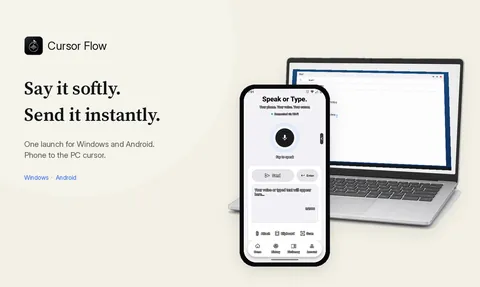
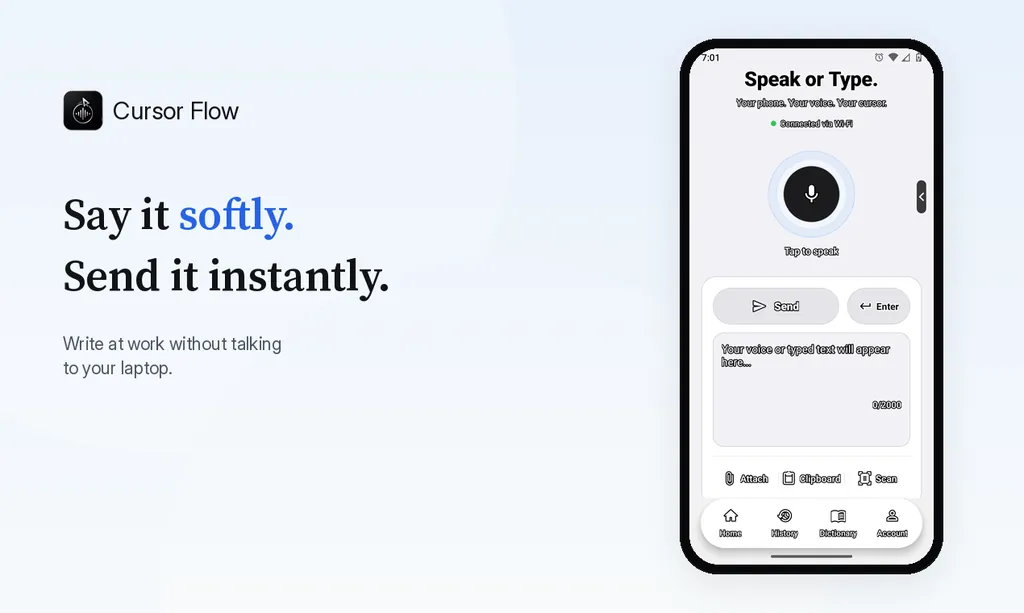
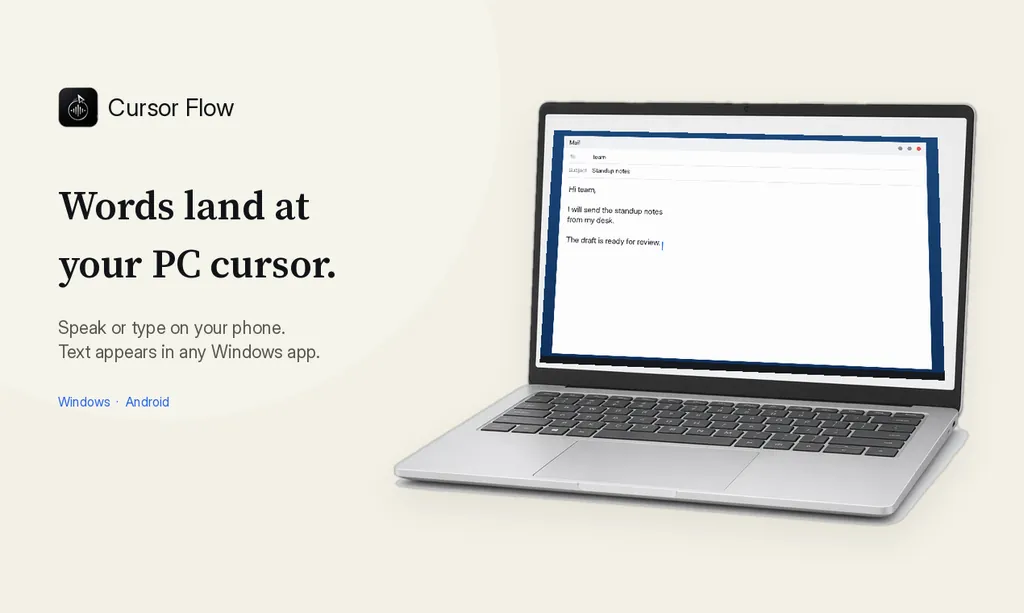
Cursor Flow lets you speak softly into your Android phone and have the text type at the cursor on your Windows PC. When you would rather not speak at all, you can type on the phone and the text appears on the PC. That second mode is described on the silent keyboard fallback page, with a walkthrough in type on your phone to your PC when you cannot speak. If your employer provides equipment as an adjustment, check their rules on approved software first.
How to do this with Cursor Flow
- Install both apps. Get Cursor Flow for Windows and Android from the download page.
- Pair once. Open the phone app and scan the QR code shown on your PC. See pairing if you get stuck.
- Click into any text field, then speak or type. Speak softly into the phone held close, or type and tap Send. The words are typed at your PC cursor, in the app you already use.
The free plan includes 2,500 dictation words a week, typing on your phone into your PC cursor, phone-to-PC files, images and clipboard, and Scan. See pricing, how phone to PC works, and silent typing from your phone.
FAQ
Is anxiety a disability at work?
It can be. In Great Britain, Acas says a mental health problem can be a disability under the Equality Act 2010. In the US, the EEOC says you can get an accommodation for a mental health condition that would substantially limit things like concentrating, communicating or interacting with others.
What are examples of reasonable adjustments for anxiety?
Common examples include flexible hours, more frequent short breaks, a quieter workspace, an agreed communication method such as avoiding spontaneous phone calls, written instructions, regular check-ins and some work from home.
Do I have to tell my employer my diagnosis?
Not always in detail. The EEOC says that in the US a more general description, such as anxiety disorder, may be enough in documentation. You do not have to tell your colleagues.
How do I ask for an adjustment?
Tell your manager or HR that you need a change at work because of a health condition, explain how it affects your work, and suggest one or two specific changes. Putting it in writing helps.
Is this legal advice?
No. This is a general guide. Rules differ by country and employer, so check with HR, Acas in Great Britain, the EEOC in the US, or a qualified adviser.
A quieter way to write
If speaking out loud at your desk is part of what makes work hard, you can download Cursor Flow and try speaking softly on the free plan, which includes 2,500 words a week.
- 57languages
- 2,500free words a week
- Windows + Androidone paired workflow